Training Tip: How Well Does Your Emergency Handbrake Work?
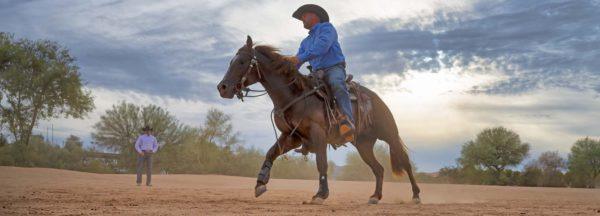
Anytime you feel as if your horse is out of control, you should be able to slide your hand down one rein and immediately bring him to a stop. Teaching your horse how to do a One Rein Stop is like having a big red emergency button on your saddle horn that you can push anytime you need to bring your horse to a stop. That’s why I like to refer to it as your emergency handbrake—just like when you’re driving your car and pull the emergency brake, when you do a One Rein Stop with your horse, everything should stop NOW.
Why It Works:
What most people don’t realize is that they have better control of a panicked or out-of-control horse with just one rein. In fact, I have a saying I tell people to remember: One rein for softness and control; two reins to get killed.
Why use one rein instead of two to control a horse? Using two reins makes a horse feel trapped, and it’s very easy for him to get leverage by lifting his head and neck up and pushing against the rein pressure you have on his face. With just one rein, you can make the horse bend his head and neck laterally, causing him to yield his hindquarters.
If you teach your horse how to properly do a One Rein Stop, you’ll always have control of him and be able to prevent a dangerous situation before it happens. You should be able to flex your horse’s nose to your toe, have him stop moving his feet and soften from the walk, trot and lope. Anytime a horse disengages his hindquarters, his gas pedal and balance are immediately taken away from him. It’s like pushing in the clutch of a car. Without a gas pedal, he can’t go anywhere, and without balance, he can’t rear or buck.
Horses don’t like being scared, so when you’re in control and give them leadership, you’ll be amazed at how fast they’ll start to relax in any situation. However, in order for the One Rein Stop to work effectively, you have to prepare and teach your horse how to react when you sit back in the saddle and slide your hand down the rein. Otherwise, when he’s panicked and running from a perceived danger, he’ll get confused and panic more when you pick up on the rein.
Sliding your hand down one rein to stop the horse has to be second nature to you as well. When an emergency situation occurs, you can’t stop and think what to do. Sliding your hand down one rein to stop the horse has to be an ingrained habit. The only way that happens is by practicing it over and over and over again.
Why You Should Practice It on the Trail:
Even though you’ve already taught this exercise to your horse in the arena, it’s important to reteach it outside of the arena to reinforce to him that you can shut his feet down anytime you want, at any gait. Also keep in mind that just because you can do a One Rein Stop at a walk doesn’t mean you can do it at a lope. You have to practice it at all three gaits.
On average, you should spend 10 minutes practicing the exercise at each gait. If you’re on a really hot horse, do a full 10 minutes at the walk, then the trot and then the lope. If you’re on a cold-blooded, lazy horse, you can probably get away with doing seven minutes at each gait. Just keep in mind that this exercise is for your benefit just as much as the horse’s. Every time you practice sitting deep in the saddle and sliding your hand down the rein, you’re building your muscle memory so that when your horse spooks and you need to stop him, you can do so efficiently and safely.
Have a horsemanship question or looking for more training tips? Check out the No Worries Club.
