Training Tip: Does Your Horse Have Magnets or Anticipate?
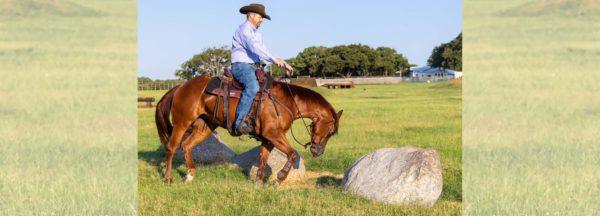
When you take your well-behaved arena-trained horse on the trail for the first time or if trail riding isn’t a regular occurrence, you’ll likely be surprised about how distracted he is outside the arena. Maybe he keeps trying to turn around and gallop back to the barn. Or he sees other horses up ahead on the trail and wants to take off after them.
All horses have what I like to call magnets—objects they are naturally drawn to. Magnets can be things like the arena gate, the barn, other horses in the arena, his buddies back at the barn, the trailer, etc. Your horse might lope slowly heading away from home but pick up his pace when you’ve got him turned toward the barn.
If you want your horse to focus on you out on the trail, you have to train him to do so. Confused Loping is an exercise you can use to see if your horse has any magnets and then correct them if he does.
Why It Works:
To practice Confused Loping, you’ll lope your horse on a loose rein. Anytime you feel the horse lean in a particular direction or anticipate turning, you’ll turn him 90 degrees in the opposite direction.
It works because every time you feel your horse picking up speed in a particular direction, leaning a certain way or trying to guess which way you’re going to turn him, you’re going to turn in the opposite direction. If he wants to go left toward his pasture buddies, you’ll turn him right. Eventually, he stops trying to veer off course because every time he does, you redirect him.
This is also a great exercise for horses that tend to anticipate your cues. When a horse thinks he knows what you’re going to ask him to do, he starts getting ahead of you mentally. Hot horses tend to do this a lot. They’ll be five miles ahead of you, which isn’t a good thing. You always want your horse tuned in to you and listening to your cues.
Why You Should Practice It on the Trail:
Confused Loping keeps a horse honest and checking back in with you. Asking him to change directions requires him to collect and slow down. He’ll have to shift his weight off his front end and start working off his hind end and develop a better cadence to his feet. You’ll also find that after practicing this exercise, your horse will travel much straighter.
I recommend practicing the exercise for 10 minutes at a time. Be an active rider and guide him; don’t just sit on him like a sack of potatoes and be a passenger. The more changes of direction you do, the more he’ll stay dialed in to you. After three to four sessions of this exercise, you’ll find your horse will completely stop guessing which way you’re going to turn and will wait for your cue and travel in a much straighter line.
Looking for more training tips? Check out the No Worries Club. Have a training question? Send it to us at [email protected].
