Help Your Horse Overcome Head-Shy Issues
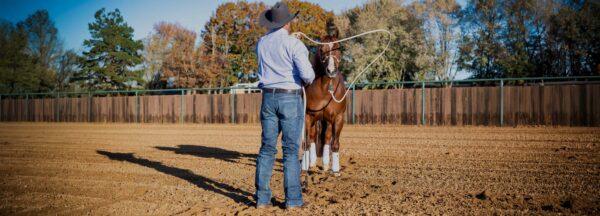
A horse that is head shy, refusing to let you touch his face, is difficult to work around, and this often leads to dangerous situations. Most horses are naturally protective of their heads being touched because the head is one of the most sensitive areas on their bodies and they need every part of it to survive. Some horses are naturally more defensive than others.
Whether a horse has a head-shy problem or he’s a yearling I’ve bought for my performance horse program, I teach all horses the Head Shy Exercises from the Fundamentals Series. There are three exercises: 1) Flicking Water, 2) Backhand and 3) Flipping the Lead Rope.
If your horse is head-shy, the exercises will help solve the issue. If he’s a young horse or even an adult horse with no known issues, it’s a good preventative step in stopping the behavior from ever starting.
When you work on the head-shy exercises, here are three important success tips to keep in mind.
Set Your Horse Up for Success
Working on your horse’s head-shy issues and introducing the exercises in the Fundamentals Series is something you should do after you’ve done some groundwork with the horse and have him using the thinking side of his brain. Set him up for success. Don’t drag a horse that’s been cooped up in a stall for the last 24 hours and is full of beans out to the middle of the arena and think he’s going to stand still.
Find a Starting Point
No matter what you’re teaching your horse, it’s important to find a starting point and build from there. Every horse is going to have a different starting point with these exercises. Some horses aren’t going to care at all about you waving your hands next to their heads. Other horses are going to run backwards as soon as you approach them and raise your hand. If your horse is an extreme case and is very frightened, you might have to stand farther away from him while you move your hands or the lead rope, and then work your way closer to his head.
Once your horse is confident with you waving your hands and then the lead rope next to his head, then you can start to incorporate other objects. However, if he isn’t confident about just your hands or the lead rope moving next to him, don’t even think about using plastic bags, clippers or other scary objects. The horse has to be confident about the easiest objects before you increase the challenge and introduce scarier ones. Otherwise, you’re going to wreck his confidence.
Consistency is Key This exercise isn’t something that you can do once or twice a week with the horse and expect him to overcome his fears. It needs to be done several times a day to be most successful. The more consistently and frequently you do it, the better this exercise works. For example, you can practice for a couple of minutes in between sensitizing exercises. Desensitizing works best if you use it in conjunction with sensitizing exercises because it gives him a reason to want to stand still.
