Make Sure Your Horse Drinks “Clean”
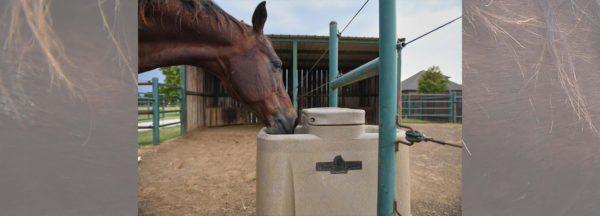
Most of us are familiar with the “eating clean” nutritional trend that has influenced the proliferation of organic, whole foods and healthy eating for both people and animals. This commitment to providing the best nutrition possible should start with the one nutrient that plays the most vital role in the health of your horse – water.
Water is by far the largest nutrient you supply to your horse in both volume and weight. The average horse drinks between 8 to 12 gallons of water daily which is roughly equivalent to between 66 and 100 pounds. For this reason, it is imperative that your horse drinks “clean.”
“Clean” is a Commitment to Providing Your Horse Clean, Fresh Water on Demand
Your horse needs access to clean, fresh water at all times. Providing enough clean water through buckets or stock tanks can be a challenge. Horse owners everywhere know how time consuming it is to check, clean, haul and refill water buckets or stock tanks on a daily basis. Water buckets also collect food debris and other pollutants, and stock tanks hold a larger capacity of water that can quickly become a breeding ground for algae and mosquitoes.
According to Roberta Dwyer, DVM, and Professor at the University of Kentucky College of Agriculture, Food and Environment, it is recommended that buckets or water troughs routinely be scrubbed and cleaned, preferably once a week. Dwyer recommends diluting one cup of household bleach to five gallons of water to disinfect any troughs that have algae, mold or for disease control during warm months. Troughs cleaned with a disinfectant need to be thoroughly rinsed several times prior to refilling to remove any bleach or disinfectant residue.
There is an Easier and Eco-friendly Option – Automatic Waterers
Automatic livestock waterers, like the best-selling Ritchie brand, are designed to provide clean, fresh water on demand at a palatable temperature in a smaller capacity trough that is easy to keep clean.
“Ritchie Industries manufactures a full line of equine waterers designed specifically for horse health and well-being, like the StallFount or AutoFount series,” said Jeff Miller, Sales and Marketing Director at Ritchie Industries. “Our patented design conserves water because our valves have a very quick refresh rate which provides water on demand. Take the Classic StallFount for example, this waterer has a stainless-steel cover and trough which is easy to keep clean with just a brush and a capacity of just one gallon. This means when you do need to clean it, you are only using one gallon of water to clean versus a stock tank of water which could be anywhere from 50 to 100 gallons plus the water required to rinse out all the debris, algae and disinfectant. If you clean your tanks out twice a month that could conservatively be close to 3,000 gallons of water wasted per tank in a year. Also, Ritchie waterers are the most reliable on the market. You’ll have no worries about leaky floats or cracked troughs. All our products are backed by an industry best 10-year warranty.”
Another major advantage of automatic waterers is that the water circulates and is not stagnant. This eliminates mosquitoes and their larvae which can carry Eastern equine encephalitis (EEE), Western equine encephalitis (WEE), Venezuelan equine encephalitis (VEE) and West Nile virus.
To learn more about planning, selecting and installing automatic waterers, visit RitchieFount.com today. Ritchie Industries is headquartered in Conrad, Iowa, and was the first company to patent the automatic water valve in 1921. Ritchie has manufactured and sold over 3 million units globally.
