Training Tip: Horse Continues to React to the Saddle After Numerous Saddlings
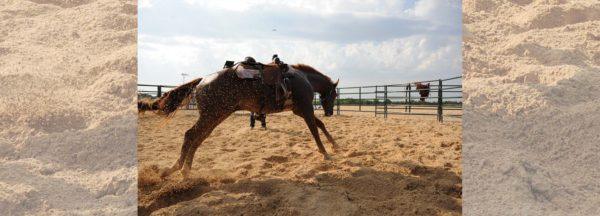
Question: I have a mare that I’ve started with the Colt Starting Series. She has responded well to the training, except she is still reactive to the saddle, even after saddling numerous times. She saddles sometimes and does not panic, and the next day, I will do the same saddling process and she will panic and start bucking. I immediately start doing Lunging for Respect Stage Two and she will stop. How do I help her stop reacting so she can get her first ride? – randy962001
Clinton’s Answer: Your colt is reacting to the saddle because she’s not truly comfortable with it and confident about it being on her. And unfortunately, you’ve let a bad habit get established. I would say that 50 percent of horses will buck with the saddle and 50 percent won’t the first time you saddle them.
The first time I saddle a horse, he’s allowed to buck. As soon as I get the saddle on him, I’ll just get him going around the roundpen and let him just get used to wearing the saddle. A lot of horses will stand calmly while you do up the cinches, but once they start moving and feel the cinch around their girth area, they come unglued. If the colt is going to buck, I want him to buck as hard as he possibly can to try to get the saddle off his back. He needs to realize that he can buck as hard as he wants, but he’s not going to get rid of the saddle or the pressure around his girth.
Once the colt is moving around the roundpen in both directions at all three gaits, I turn him out in a big, safe arena to just let him get used to wearing the saddle. The key to successfully saddling a horse for the first time is to get his feet moving forward and to give him time to get comfortable wearing the saddle. So, if I were you at this point, I would let your horse wear the saddle for six to eight hours. You have to turn her out in an area that’s fairly large so that she has room to move her feet. A roundpen is too small.
What usually happens is the colt will run around bucking and then he’ll settle down. Then all of a sudden the stirrup will touch his side and he’ll take off bucking again. Then he’ll relax and fall asleep, and when he wakes up he’ll see the saddle on his back and take off snorting and bucking again. You’ve got to give him the opportunity to try and get rid of the saddle and realize he can’t. If all of a sudden the colt grew a mane and tail, he’d be just as frightened of them. But because he was born with his mane and tail and has had his whole life to get used to them, he’s not frightened of them. You have to let him wear the saddle long enough so that it just becomes second nature to him.
The worst thing you can do is saddle a colt up and then take the saddle straight off. You never want to take the saddle off until he is absolutely convinced that he can’t get rid of it and that it’s not going to harm him. If you come back after eight hours and your horse is still snorting and bucking with the saddle, leave it on her all night. Put some hay and water out in the arena and leave her alone. If she’s really frightened of the saddle, you may have to keep it on her for two days. Do what you have to do to get the job done. The secret is to not take the saddle off until the colt is ignoring it.
A big key to getting your horse used to the saddle is making sure that she moves around with it a lot. It won’t work if she just stands in a corner of the arena all day because then she never gets to feel it moving around on her. When we start our colts in the spring, I like to saddle them in groups. We’ll saddle all the colts and turn them out together in one arena. Then we’ll saddle all the fillies and turn them out together in another arena. That way, they keep each other moving around all day long. If I have to saddle one horse by himself, I’ll turn him out in an arena that I know people will be riding in all day. That way, if someone is riding around and notices the colt just standing in a corner, they can go chase him around a little. I can’t stress enough the importance of making sure your horse moves around during the day. If she doesn’t, it will defeat the whole purpose of turning her out.
Have a horsemanship question or looking for more training tips? Check out the No Worries Club.
